| back to Spring Garden |
| |
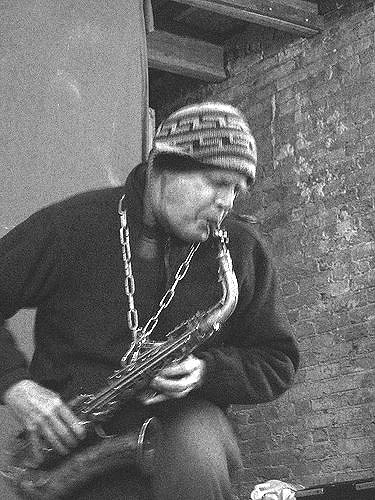
let's start with the shortest Jack Wright responds to the word "musician" and "saxophonist" (among others) and is mild-mannered in most social situations, doesn't kill most animals, and obeys most road signs. He improvises, sometimes astutely, sometimes foolishly, but never with the intent to make something called "music." Whatever it is, more sounds come out of his horn than you are likely to have heard. more information, if desired Jack Wright is an American saxophonist (Philadelphia area) and free improviser who disdains association with existing scenes and is not to be compared with any other saxophonist. At 76, he is still unmarketable, and finds in that a freedom he enjoys rather than regrets. One of the few originals of American free improvisation in the 80s, he was then touring the countryside with blow-your-brains-out free jazz. By the late 90's he found that boring, repetitive, and too acceptable. Wright has shifted quite a few gears and is now in top form, not hesitating to disappoint audiences looking for the art-crowd comfort zone. He holds to the old spirit of adventure: each instant of playing is fresh, twisting all he has done into new gestalts. His vocabulary keeps expanding and he uses it all, one long Joycean sentence (with strange ellipses), whether playing alone or with partners. He wrote THE book on free improv, The Free Musics, a philosophy of music and a historical-sociological study that puts the mass of players at the center of the story. A bit more conventional: Described twenty years ago as an "undergrounder by design," Jack Wright is a veteran saxophone improviser based mainly in Philadelphia. He has played mostly on tour through the US and Europe since the early 80s in search of interesting partners and playing situations. Now at 76 he is still the "Johnny Appleseed of Free Improvisation," as the late guitarist Davey Williams called him in the 80s, on the road as much as ever. He continues to inspire players outside music-school careerdom, playing sessions with visiting and resident players old and new. His partners over the years are mostly unknown to the music press, and too numerous to mention. He's said to have the widest vocabulary of any saxophonist, including leaping pitches, punchy, precise timing, sharp and intrusive multiphonics, surprising gaps of silence, and obscene animalistic sounds. He has had a book published, Jan. 2017, The Free Musics, which is becoming very popular among improvisers. A reviewer for the Washington Post said, "In the rarefied, underground world of experimental free improvisation, saxophonist Jack Wright is king". But for a true assessment listen to the music he and his partners create: Spring Garden Music, for sounds and writings. still more info Described twenty-five years ago as an "undergrounder by design," Jack Wright is a veteran saxophone improviser based mainly in Philadelphia but living in Easton PA. In 1979, after an academic career teaching at Temple University (European History) and activist politics, he returned to the instrument of his youth. Almost immediately he discovered free improv, virtually unknown at the time; he is one of the few who have played this exclusively since then. He plays mostly on tour through the US and Europe in search of interesting partners and playing situations. Now at 76 he is still the "Johnny Appleseed of Free Improvisation," as the late guitarist Davey Williams called him back in the 80s, continuing to inspire musicians, playing and organizing sessions and gigs with visiting and resident players old and new. His Spring Garden Music House has been around since 1977, for the past twelve years housing only improvisers and providing space for sessions. He has been able to avoid the standard career aimed at visibility and prestige, seeing it as a hindrance to musical growth. The partners he's preferred over the years have also been mostly unknown to the music press, and too numerous to list here. His current focus is with the ever-changing underground scene, of whom he finds the most promising to be his partners Zach Darrup, guitar, Evan Lipson, double bass, Ben Bennett, percussion, Matt Tomlinson, bass guitar, Ron Stabinsky, piano, and Patrick Crossland, trombone. Jack is a "musician's
musician" yet unschooled in music, developing through interaction
with partners and his version of private discipline. He's said to have
the widest vocabulary of any, an expert at leaping pitches, punchy,
precise timing, the entire range of volume, intrusive and sculptured
multiphonics, vocalizations, and obscene animalistic sounds. You'll
hear the most conventional jazz sound one minute and "post-electronic
saxophone" the next. His playing sums up his 40 years of improvising,
from lyrical, Ornette-style free jazz at first to the hard-blasting
version, very reduced, quiet playing around 2000. In the past ten years
he's come back to more physically engaged playing, but with a phrasing
and space unique among sax players. And finally the official version, the resume: JACK WRIGHT Alto, soprano,
tenor saxophones; piano Since 2000 he has renewed his label, Spring Garden Music, which presents his own music and that of his partners and are listed here. He published The Free Musics in Jan. 2017, which has become qutie popular among improvisers. Wright was interviewed by Cadence Magazine, which is located here: Cadence Magazine July 2017, p. 55-73 He continues to seek out new partners; in 2002 and every year since he has returned to Europe to that end (list of tours). Those partners living in Europe with whom he has been playing most consistently the past decade are Pascal Battus, Paris; Alberto Braida, piano, Milan; Sebastian Cirotteau, tpt, Toulouse France; Phil Durrant, computer, violin, London; Michael Griener, drums, Berlin; Joel Gripp, double bass, Paris; Grundik Kasyansky, electronics, London; Hans Kocher, bass cl., Switzerland; Urs Leimgruber, saxes, Lucerne Switz; Andrea Neumann, inside piano, Berlin; Agnes Palier, voice, Rambouillet France; Adam Eve Risser, Paris; Stephan Rives, soprano sax, Beirut Lebanon; Sharif Sehnaoui, guitar, Beirut; Christine Abdelnour Sehnaoui, sax, Paris; Fabrizio Spera, drums, Rome; Olivier Toulemonde, percussion, France; Guillaume Viltard, bass, Lyons, France; and Sabine Vogel, flute, Berlin, Christopher Williams, double bass, Berlin. He has been especially active in bringing European, especially French musicians to tour in the US. His major tours of the past fifteen years, in retrograde order,have been in North America unless otherwise mentioned: with Roughhousing
in Europe, March 2019; with Evan Lipson in Europe, Nov. 2018; with Roughhousing
in Canada and US, Sept. 2018;with Roughhousing on West Coast, April
2018; with Zach
Darrup in Europe (Sept. 2017);Roughhousing
(fall 2016, spring 2017);
Bob Marsh (April 2016);, Zach Darrup (Nov. 2015), Wrest
(June 2014, Sept. 2014, April 2013, Sept. 2012); Europe with various
partners (Oct. 2011); the West Coast ( Fall 2010), with Bob Marsh (two
US tours 2010 and 2011); with Pascal Battus
on the east coast (2010); Europe (March 2010); the Northwest (Feb. 2010);
with Fabrizio Spera and Albert Braida on the east coast (2009); a
trio of Guillaume Viltard, bassist, and Grundik Kasyansky, electronics
in France, the Netherlands and Belgium; with Michael Johnsen, midwest;
with Fabrizio Spera and Gust Burns in the Northwest; with Andrea Neumann
and Stephane Rives on the East Coast (the Snowball Tour, 2008, joining
also with 11 other musicians); with Andrew Drury in the Balkans; with
French soprano sax player Michel Doneda and percussionist Tatsuya Nakatani
(From Between) in the US twice, France, and Japan, 2003-2007; with Agnes
Palier and Olivier Toulemonde in Europe and the US East Coast; with
Carol Genetti, vocalist, and Jon Mueller, perc. (NomTom) in France and
the US; with Pittsburgh electronicist Michael Johnsen and Sebastien
Cirotteau of Toulouse, in Europe and the US; with Ben Wright, bassist,
in the US; with Doneda and Nakatani in Japan, France and the US (30
performances); and a cross-country tour with Michael Griener percussion
and Sabine Vogel flute of Berlin (2004); US tours with Reuben Radding
and with Phil Durrant (2003). |
|
Feature in Signal to Noise Magazine
Interview in Avant Music News Jan. 2014
interview with Jack by John Berndt (also disponible en francais, as published in Improjazz)
Tom Djll's journal of our 2002 east coast tour--descriptive, humorous, and analytical
Contact: jackwri555 AT gmail DOT com
--more elaborate descriptions of SGM recordings are found here.
A variety of music can also be found on the Sounds page, Jack Wright Soundcloud, Spring Garden Soundcloud and Spring Garden Music Bandcamp
Internet Archive recordings in chronological order:
Assorted Treats cassette released 1986, a better quality of which is to be found at Sample Tape 1979-1985
Everybody Loves Texas cassette from tour with Andreas (Max) Stehle, saxophone 1987, released on Sound of Pig (Al Margolis)
Tampa FL. Solo, released privately as cassette, 1988
Boulder Trio with Barry Gilbert, tpt, Peter Halter, drums, plus a fourth track of larger session, 1990
Killtime duo with Murray Reams, drums, 1991
Radio lnterview in French on Taran's Free Jazz hour with guest Noel Tachet concerning the music of Jack Wright, 2004(?)
Toshi Makihara, Evan Lipson, Jack Wright, Phila., 2006
Olivier Toulemond, Agnes Palier trio in Berlin, 2006
Grundik Kasyanski/Jack Wright, Grundik on electronics in NY 2006
Guillaume Viltard/Grundik Kasyansky/Jack Wright, Huyswerk Concert, Antwerp Belgium 2008
Johan Nystrom/Jack Wright, Paris, 2011
Jared C. Balogh/Jack Wright, Allentown PA 2015
Spring Garden Group various groupings in Saylorsburg PA and Mt. Airy-Philadelphia shows
Ron Stabinsky, Jared C. Balogh, Zack Darrup, Guillaume Gargaud, Jean Philippe Gomez, Jack Wright, Scranton PA 2015
Adam Pultz, Jared C. Balogh, Jack Wright, Allentown PA 2015
Ed Cho, Joel Kromer, Jack Wright, session, Easton, 2015
Saxophone Soup, eleven saxophonists, Philadelphia Aug. 2015
Davey Williams, Jack Wright session, Birmingham AL 2016
Patrick Crossland, Zach Darrup, Jack Trio, at Rhizome, DC 2017
Walter Wright Duo, session, Lowell MA Aug. 2017
Reviews of the book The Free Musics NEW RECORDINGS FROM JACK WRIGHT from The Free Jazz Collective, by Tom Burris, 2016 This review covers Meet and Greet, duo of Zach Darrup and Jack Wright; Just What You Need Today, Jack and Ron Stabinsky, and This is Where You Get Off, a trio with Joel Kromer and Edmund Cho AVANT MUSIC NEWS INTERVIEW, 2014 AS IF ANYTHING COULD BE THE SAME, Relative Pitch, 2014, Jack Wright and Ben Wright "A major figure in free improv since the ’70s, Jack Wright sounds like he’s pushing himself more than ever, with formidable chops and the imagination to articulate complicated and unconventional sounds, from nimble flutters, to animalistic wild boar snorts, to string-like or even car-alarm sounds." Ernie Paik,. Chattanooga (TN) Pulse What is notable about the Wrights’ approach to sound is the way it makes audible the physical confrontation of player and instrument. In fact, much of this is music that directly signals its origin in the body. The physicality of sound production—for example the inhalation and exhalation of the breath, the undertow of voice and the sonic signature of the lips which are so prominent in Could—makes itself felt at various points throughout the set. Daniel Barbiero, AMN Reviews " The two musicians share a language comprised of staccato passages, breathy space, and intense workouts, that while unpredictable and full of surprises, is imbued with meaning and understanding....nothing like I had ever heard before." by Paul Acquaro, Free Jazz Blog (At a performance in Albuquerque NM) "The two men fed off each other; lost in their own world. [I was] impressed by the seemingly accidental, subtle coordination between the two instruments. When Jack went one way, Ben went the other, like they were anticipating the next move and knew exactly how to counteract it." Patrick DeBonis, Rave Deaf OVER THE TRANSOM: "Hell & Bunny" sounds like something you might come across over at engrish.com, but in fact it's an improv duo consisting of cellist Hans Buetow and percussionist Ben Hall (I'm not sure who's hell and who's bunny but I guess it doesn't matter), who might be more familiar to readers as two thirds of Graveyards, with ol' Wolf Eye himself John Olson. On this splendid CDR release on the Alberta-based Bug Incision imprint they're joined by another prowling wolf of American free music, saxophonist Jack Wright, and it's the most impressive Wright release I've heard since the two trio dates with Michel Doneda and Tatsuya Nakatani, from between (SOSEditions, 2003) and No Stranger To Air (Sprout, 2006). At the turn of the century, Jack Wright took a decisive step (every step Jack takes is decisive) into lowercase territory, generously acknowledging the influence of Bhob Rainey, but throughout the decade his playing, especially solo, has gradually been getting more combative again – though it's nowhere near as fiery as it was back when he started out in the early 80s. On Over The Transom, Hall's soft mallets and Buetow's elegant micromelodies and delicate pizzicati pull him back into more restrained territory, but you can tell he's just itching to burst into flames. Wright has always taken the line of most resistance as a player (I still think he should team up with his English namesake Seymour), exposing himself to as much risk as he can find. Just as well he's not a Wall Street trader. Listen to how he jams the horn against his thigh and really goes for – and gets! – those awkward multiphonics, just when the music is quiet enough to show up the tiniest mistake. This stuff is as poised as gagaku, as focused as shodo and as intense as butoh. Dan Warburton, Paris Transatlantic, 2009 AS IS: Decades
ago, before Wire year zero, I wandered into a London record store, Honest
Jon's, then located off Charing Cross Road, where a solo bass disc by
Dave Holland was on the player. "That's far out," I remarked to Wire
founder Anthony Wood, working behind the counter. "No, it's near in,"
he retorted. Even Anthony couldn't describe As Is as near in. Its three
live tracks, two on soprano and one on alto, are uncompromising solo
sax improv. Jack Wright left music in the mid-60's for radical politics.
Returning in the late 70's to free jazz, by the milennium he was playing
free improv with Bhob Rainey. If an improviser is producing tones at
all on saxophone, it's hard to avoid a jazz element, and while the alto
track starts out with noise, there's a moment when Wight is almost "soloing"
on "Three Little Words". Raw, visceral, urgent, his music demands to
be heard. Jack Wright is bright, his
playing powerful: These qualities forge an engaging combination. For
the most part, his musicianship inhabits the extremes: Usually not the
extremes of Jazz, but the extremes of free improvisation. While Wright
is capable technically of playing almost anything on his saxes, he has
of late chosen to pursue what he terms a "more feminine approach," where
the focus is on pure sound, often (but not always) filtered by unabashed
minimalism. Wright is a master solipsist; a fierce individualist in
the tradition of Howard Roark, exuding inner strength while seeking
or affirming objective truths...this is one of Wright's most esoteric
solo ventures; and for those few who are likely to appreciate it, one
of his most curious recordings. |
||
| CLANG:
From the first warm saxophone notes wrapping around even warmer piano
notes, it's clear that this is no ordinary Jack Wright record. Then again,
every Jack Wright record is a bit of a shock, so that's a rather nonplussing
statement. A particular quality that distinguishes this one is a luxurious
"chamber" sound, with the conventionally tuned notes of Bob Falesch's
piano resounding at every turn. It plays a bit like a Roscoe Mitchell
and Matt Shipp duet. Beyond this overall surface feeling, the disc is
packed with Wright's trademark un-trademark-able flood of reed newness.
Enhancing both the surprising conventional aspect and the characteristic anti-conventional aspect, the stunningly vivid recording quality (courtesy of Bob Falesch's mysterious and elaborate machinations) makes this a disc that will seduce just about anyone plugged in somewhere to the broad spectrum of post-jazz improvisation; those already primed to savor the raw edges and unsafe trajectories of Wright's saxophone will do a double-take and then proceed to play the disc repeatedly, and those who are generally a bit queasy about this sort of thing will find their attention drawn beyond the details of Wright's playing and into the larger flow of conventionally rich and beautiful instrumental sound, finding the piano to be a counterbalance to any suspicious reed episodes.... --Mike Parker, Bagatellen, concerning the CD Clang, Zeroeggie Ox-2bdf |
||
| |
|
| |
NOM TOM:
These two extended improvisations feature the indefatigable road warrior
of American improv, saxophonist Jack Wright, with two younger playing
partners, percussionist Jon Mueller and vocalist Carol Genetti. Genetti
is one of the more discreet improvising vocalists: there are no full-blown
hysterics and theatrics here, just a patient exploration of tiny twitters,
bleats and delicate overtones – imagine a small furry animal Tuvan
throat singing – and Wright accordingly spends much of the time
with his sax jammed tight against his trouser leg, muffling and filtering
the sound much as he did on the exquisite series of albums he released
a while back in the company of Bhob Rainey. Mueller's the wild card here,
deftly avoiding classic improv percussion's nervous clatter and ping to
concentrate on in-depth research into his beloved snare drum. The second
track is more adventurous, filling the empty spaces of long dead reductionism
with a whole range of sustained sonorities; about halfway through it turns
into a veritable jungle (Indian, presumably, given the album title's reference
to North Indian classical music), with Genetti squawking like a demented
parrot and Wright growling menacingly in the undergrowth, while Mueller
ticks away like a death watch beetle, leading the others into a nocturnal
hooting contest. It's fascinating, superbly paced and impressive work,
well worth checking out. --Dan Warburton, Paris Transatlantic, Nov. 2005, |
|
| |
FROM BETWEEN:
Many practitioners of lowercase Improv nowadays sound like they're going
through the motions. Saxophonists and trumpeters spit, dribble, gargle
and drool, guitarists and percussionists scratch their prostrate instruments
as if they were pimples, and laptoppers sit statue-like behind their luminescent
Apples fizzing like soluble aspirins. But albums like this show that lowercase
definitely need not mean 'lacking in intensity and commitment'. Saxophonists Doneda and Wright have been active on either side of the Atlantic for going on 25 years, and each has recently contributed landmark documents to the solo sax repertoire, but the eventual collaboration that happened on Doneda's recent US tour turns out to be even better. Both are sufficiently inquisitive (and stubborn) not to rest on their laurels. --Dan Warburton, The Wire, Sept. 2004 BIRDS IN THE HAND: When two legends of american improvised music decide to share with us the space of a moment, their passion for the duo, we can only be curious, then won over. The saxophonist Jack Wright remains the most indispensable musician of his generation. A true catalyst of energy, indefatigable explorer, conjurer of white magic in a music inspired by black, he is still the reference par excellence for all the generations who have followed. As for Bob Marsh, he can be described as an agitator of the american alternative scene. Showing up everywhere, from California to Chicago, he brings his freshness and vigor of renewal to all projects in which he participates. We can understand from this past why he is still so courted. Birds in the Hand includes all the qualities and surprises we can expect, with a bonus of rare humor and complicity. --Sébastien Moig, Jazzosphere no. 19 (French publication) |
|
| |
PLACES
TO GO: In the rarefied, underground world of experimental free
improvisation,saxophonist Jack Wright is king. For over 20 years as a
pioneer of extended techniques like overblowing, tongue clicks, multiphonics
and microtones assembled in spontaneous compositions, Wright’s been
an inspiration, mentor and musical partner to many players. Here, with
silence as his only foil, Wright solos in various live settings, creating
a technical primer that demonstrates ecstatic flights of musical imagination
unfettered by euphony or meter.
Wright plays more wildly in Baltimore and more meditatively in Boston, but it sounds like he has the most fun recording in his own Boulder, Colorado, kitchen. Drawing on a vast vocabulary of hisses, clicks, pops, howls and siren blasts amid conventional tones, Wright blows complex, quickly flowing phrases that showcase not just creative virility but tremendous healing sanction-offering holy water from the horn of plenty. With nimble fingers--and an embouchure to die for (lips and tongue becoming subtle acrobats challenging a high blown wire without a net)--Wright ties his axe in knots and unties it with the dexterity of a prestidigitator. His mysterious, un-sax-like tones may sound like something imagined by a science fiction writer creating a Martian culture, but one thing the sax does exceptionally well is imitate the human voice, and Wright furthers this tradition of soulful cries by blending his own guttural or shrieked voicings with those of his instrument. Despite its difficulties, Wright’s music remains human and exciting because it is clear and true. --Jeff Bagato, the Washington Post, April 27 2001 |
|
| |
THE DARKEST
CORNER: Increasingly, American improvisers have been looking
as much toward European free improvisation and electro-acoustic explorations
as they have toward the Free Jazz tradition for inspiration and opportunities
for cross-fertilization. This recording provides a look at how musicians
operating on the fringes are synthesizing this approach to create vital,
expansive improvisation. The Darkest Corner, the Most Conspicuous
brings together two generations of improvisers. Jack Wright and Bob Marsh
are staunch individualists who have been practicing their art for over
four decades; Wright from his base in Colorado and Marsh around Detroit.
Bhob Rainey has been an integral figure in the Boston improv scene, though
he has also spent time recently in Chicago. Lonberg-Holm is the fourth
member here. The four have hooked up individually over the years, and
this recording was made during a tour they put together. The pairing of
two reeds and two cellos is a masterful combinations in the hands of these
improvisers. Each is concerned with the tones between the notes, the space
between the sounds, and the interaction of the two in an ensemble.
There is an intimacy in this music, but rather than being conversational improvisations, the four come together to make music that is intrinsically interwoven. Each of the players spin intricate lines, but it is how these lines come together that creates the whole. There is a delicacy as they move from a hushed whisper to heated intensity. Throughout, there is an openness to their playing as they all maintain a collective balance to their spontaneous abstractions. Wright brings a free Jazz sensibility to the music, his grittier tone providing an effective foil to Rainey's sliding tonalities and stuttering percussive flurries. The two cellists constantly shift from linear arco to scrabbled textures as the woodiness of the instruments' tone ping-pongs off the breathiness of the horn players. Ideas are collectively molded and through these compact collective structures, it becomes next to impossible to keep track of the individual voices. This release is an acknowledgment of how improvisation continues to grow in the hands of musicians working independently to foster collective, spontaneous interaction. Listeners should also be appreciative of labels like CIMP for fostering and documenting sessions like these and making this music available." --Michael Rosenstein, from a review for Cadence Magazine, 2000 |
|
| |
PERFORMANCE
AT 1999 HIGH ZERO: Wright was one of the jewels of the
Festival, a player with awesome technique and few evidently predisposed
notions. Capable of passion-filled bursts that abruptly end, followed
by gruff honks, slap-tongue, and a unique eclectic attack, Wright enthralled
with his constantly surprising turns. Dressed in lavender shorts, Wright
purposely makes a comic appearance, and when combined with his shtick
(such as a soda can stuffed in the bell, or chasing around on stage like
one of the Marx Brothers), the results are as visually appealing as the
music is aurally attractive. In all, one of the most successful events
of the Fest. [This set included four percussionists]
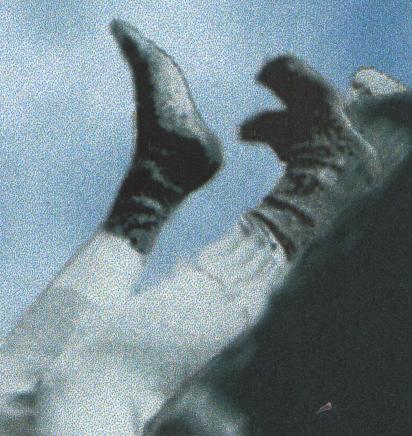
[In another set] Wright is one of the most interesting and eclectic saxophonists on the scene. He plays sui generis, something that, when you consider the innovations on saxophone in recent years, is a remarkable feat. Wearing his characteristic purple shorts and mixed colored socks, Wright seems to blow without preconceived notions. He blows air, stuffs his horn with curiosities, launches enigmatic lines, and seems to create bursts of notes in reverse order. On soprano, his advanced techniques enthrall, as his mind works at super speed. Zornish at times, his squeaks and screeches are less random than coordinated, sporting little sounds, mouthpiece treasures, and spitting forth pings and pops: Donald Duck meets Evan Parker. --Steven A. Loewy, Cadence Magazine, Nov. 1999 |
|
| |
i can't
stand myself when i hear Jack Wright! the man is a secret master of the
universe. he waltzed into Baltimore last saturday, ate a quick meal of thai food
with me and played an impromtu set at the red room and basically performed
something like a lobotomy on me. everyone agreed. you just need to watch,
listen and smell the man for yaself.
--tom boram, Baltimore, May, 1999 |
|
| |
His musical
language has the shape of a stream of consciousness in which the colours
are made by a big repertoire of "strange" sounds, growls, overtones, multiphonics
all played with strong feeling. He has very personal opinions about music
and keeps himself out of the musical establishment to look for a more human
and convivial relation with the listener
---Gianni Gebbia, Curva Minore, 1997 |
|
| |
"The startling
quality of Jack's improvising is its 'concreteness,' by which I mean that
it seems not to refer to anything outside what he is doing the moment you
hear it. Looked at from a music theory standpoint you could break it down
into streams of extended techniques, 'non-metric rhythms' and often 'non-western
pitches', but it doesn't strike me in that way. The parts have a fluid unity
and elemental range that I don't associate with 'music' or the saxophone-perhaps
that's why I like it so much. The sound of a continually transforming timbre,
a densely packed phrase that holds together, points towards a macrocosmic
view, towards a choice of different listenings.
Jack's playing is replete with the feeling that it is spontaneously structured on many different levels at once, and that you can choose to listen to different energies that run through it. It is truly polyphonic music, played on traditionally monophonic and linear instruments. Jack Wright's playing involves a constant self-reflexive listening. He listens intently to the sounds that he produces, and reacts to them as if they were another player -- it gives Jack's playing an eerie feeling of time, as if each moment were supremely contingent on the last, each a turn from the last. This sits well with my feelings of nihilism: that we are reinventing the world in each interaction. --John Berndt, Baltimore, 1993 |
|
| |
"Each
improvisation had a unique logic: all followed strong linear rivers of consciousness,
in which ideas developed slowly and thoroughly, almost Beethovenly. Improvisors
know of the flickering of openings which tempt us away from that realm which
we have set out to explore. Wright managed to keep his concentration, I think,
by listening intently to himself: between phrases he would make tiny vocalized
responses: a laugh or a surprised or approving grunt. The audience too listened
closely and attentively. An entirely exceptional concert"
--Dan Plonsey at Berkeley Store Gallery, Dec. 13, 1992, in Freeway |
|
| |
"vitality
and rampaging musical hullabaloo Get bored at a Jack Wright event? Impossible.
He not only hears but sees the trail the music will follow. His sax can
turn out express-train runs of short, rattled notes, then switch to slow,
weaving threads punctuated by heavy voiceless breaths or even squealed vocal
syllables. Virtually every time, the change in direction is exactly what
you wanted to hear without knowing it. I'm not enough of an analyst to know
how good he is technically, but Jack just might be the finest musical player
I've heard this side of Indian master Ali Akbar Khan.
I think most people find it hard to live with unpredictable music. I wish it was all like that-screaming messengers of Pan hurling themselves into the mists with engine full throttle and brake lines cut. Just listening-unquestioning, accepting, letting it fill me-I found that a curious thing happened. By my acceptance, I became the completing instrument, not only interpreting what I heard, but creating its final form. So even I, with my leaden fingers, was performing in a public place. That's a hell of a gift to receive, Jack. Come back soon." --Derek Davis, Welcomat, Oct. 21 1992, Philadelphia |
|
| |
"For sheer
maximum sax bravado, no one matches the intensity of Jack Wright, including
Brotzmann or the Borbeto boys. Though his sometimes minimal approaches remind
me more of someone like Luc Houtkamp, Jack is a positive electric force that
just will not stop until the whole house is up on chairs dancing. You will
smell the sweat beading on his balding head. You will writhe in agoney and
delight. You will come away from the experience no better than before, but
what fun, huh?"
--Glen Thrasher, lowlife magazine, Atlanta 1991 |
|
| |
PERFORMANCE with Andreas Stehle in Germany: "Musik die Bisweilen ins Animalische Geht" : We heard music that for long periods
left all known paths or, the other way around, in its strangeness and expressive
power made us aware of the narrowness of these paths. Maybe the term music
is already too narrow for these experiments of sound and rhythm spreading
out to real orgies of sounds. This music becomes ritualistic, sometimes it
sounds raw and sensual. The two saxophones [with altoist Andreas Stehle]
give real mating calls and knocking sounds, the musicians bend with their
instruments and stub out the sound on their knee like a smoked cigarette.
Then the sound rises such that you're in the midst of an insect swarm. From
there it moves of itself to the spherical; we hear lovely, for short moments
almost classical sounds. These sounds seem so free of all formal corseting
that involuntarily you perceive them as genuine expression of feeling. This
music paints wildly and abstractly with a thick and bold stroke, and if you
get to listen to it for a longer time it would positively be able to pole
your brain current in a different way.
Schwabische Zeitung, March 1986 |
|